


Local Elections
As we enter the last few weeks before the London local government elections on 7 May, campaigning is stepping up across Hammersmith and Chiswick. All London boroughs and many other parts of the UK are having all-out elections and this of course includes the boroughs of Hammersmith & Fulham and Hounslow.
It is easy to dismiss local elections as simply being a bellwether for how the government of the day is doing. But local government is important; it provides many of the services that people rely on day to day, and who runs a local council will have a huge impact on how those services are delivered. As we head towards the local elections in May, it is worth looking at what Labour run councils have actually delivered in Hammersmith and Chiswick over the past few years.
Hammersmith & Fulham
The borough has the third lowest council tax in the country. At a time when many councils have had little choice but to raise bills significantly or cut services, Hammersmith & Fulham has managed to keep council tax down while still expanding provision in key areas
That is most clearly seen in adult social care. H&F council is the only council in England to have abolished charges for home care for elderly and disabled residents, meaning that people who need help at home are no longer faced with substantial fees for that support.
Free breakfasts are now provided to all primary school pupils in the borough. That universal approach is important. It avoids stigma, ensures that every child starts the day properly, and offers a practical saving for families at a time when household budgets are under pressure.
Alongside that sits a broader package of cost-of-living support, including a council tax support scheme that means many lower-income households pay reduced bills or no council tax at all.
On the economic side, the Upstream London strategy has helped attract around £6 billion in investment into the borough and supported the creation of over 17,000 jobs in science, technology and related industries.
The Pathway Bond, introduced as part of the strategy, is a good example of this. It is designed to connect investment with training and employment opportunities, particularly for local young people, so that the benefits of growth are not abstract but felt locally in the form of skills and jobs.
Community safety has also seen sustained investment. The Law Enforcement Team continues to provide a visible presence across the borough, dealing with anti-social behaviour and supporting the police. Alongside this, the Gangs, Violence and Exploitation Unit works with young people who are at risk, focusing on early intervention to prevent involvement in serious crime.
Hammersmith & Fulham has established a £5 million Green Investment scheme, allowing residents to invest directly in local climate and ecological projects, with a fixed return, while funding measures such as energy efficiency improvements and carbon reduction initiatives.
At the same time, the council has built one of the densest electric vehicle charging networks in the UK, reflecting a focus on the everyday infrastructure needed to support the transition to cleaner transport.
There has also been continued recognition for the borough’s green spaces. Twenty-five parks and open spaces have now received Green Flag awards, an international standard for well-managed, high-quality public spaces, covering areas such as biodiversity, environmental management and heritage.
Hounslow
Hounslow has secured a strong financial settlement from government this year, providing additional funding for local services at a time when many councils are under real pressure. That has created a more stable footing to invest in priorities across the borough rather than relying on cuts or short-term measures.
There is also a clear focus on expanding opportunity, particularly for younger residents. Plans for increased investment in youth clubs and activities are intended to ensure that young people across the borough have access to provision regardless of background or location, reflecting a broader emphasis on early intervention and access to opportunity.
On community safety and the local environment, the council is strengthening its approach through a new Enforcement Team, with a 24/7 response to antisocial behaviour and noise complaints. This is backed up by plans to increase CCTV coverage in known hotspots, improve street lighting and work more closely with the police to ensure safer routes home. Alongside this, practical steps such as the introduction of free bulky waste collection and community skip days are designed to make it easier for residents to dispose of waste properly and reduce fly tipping.
Housing remains a central issue, and the commitment to deliver 2,500 genuinely affordable homes is intended to address long-standing pressures on supply and affordability, particularly for local residents.
On the economic side, Hounslow continues to play a significant role in west London’s wider growth. The Golden Mile regeneration programme along the Great West Road brings together around £7.5 billion of investment over the next 15 years, with plans for up to 14,000 new homes and around 25,000 jobs, alongside new commercial space, and a focus on sectors such as creative, digital and technology industries. Developments already underway, including the former GSK site, will deliver thousands of homes and significant workspace, as well as a new Skills and Innovation Hub linked to the University of West London.
This is complemented by infrastructure investment, including the proposed West London Orbital rail line, which Hounslow is supporting alongside Transport for London, improving connections across west London and opening up access to jobs and development sites.
Justice News

The main justice business in the Commons recently has been the Courts and Tribunals Bill. The Bill seeks to modernise an overstretched and failing criminal justice system. Most of the Bill has been welcomed and well-received, especially the promise of additional resources for the criminal courts and greater efficiencies. However, the Bill has also attracted controversy, particularly the proposal to allow some cases that would currently be heard by a jury to be tried by a judge alone. That represents a significant shift in principle, and one that merits careful scrutiny. I set out my opinions on the Bill in a speech last week.
With the understandable focus on the work of juries, it seems to me that this debate would be better informed if there were greater scope to understand what actually happens in the jury room. At present, jurors and researchers are effectively prevented from discussing those experiences because of the risk of committing a criminal offence. The Law Commission has recommended that this should be decriminalised, and I raised this in the Commons, asking whether the Government would take the opportunity to address it in the Bill. If we are serious about examining how juries function, there is a strong case for allowing that kind of informed contribution.
The Justice Committee, which I chair, has held more evidence sessions on the Bill, and I’ve also raised the Lady Chief Justice’s concerns about the safety of judges who will now be making findings of guilt or innocence in more serious cases.
I have also been meeting with a number of litigants in person, who have had to represent themselves in court in cases involving disability discrimination, harassment and employment disputes. In each instance, they were navigating the system without legal assistance, not by choice but because Legal Aid is simply no longer available to them. Their experiences underline, in a very direct way, the gap that now exists between legal rights in theory and access to justice in practice.
We also continue to work on prison reform, having just started an inquiry onto children in prison and continuing to work on rehabilitation and drugs in prisons. I spoke to Jeremy Vine on this last issue on his Radio 2 programme today.
Other Parliament news
There was rare consensus from all parties this week on the funding for a memorial for the victims of the Grenfell Tower fire. The tower itself will soon have disappeared from the west London skyline as it is dismantled, and the Memorial Commission is debating what permanent monument there should be. I spoke in the debate to support not only funding but the need to learn the lessons of Grenfell. The best memorial is to ensure fire safety measures are introduced to prevent any reoccurrence of the tragedy and that those responsible for it are subject to criminal prosecution.
Two child limit
The Universal Credit (Removal of Two Child Limit) Bill received Royal Assent yesterday, marking a significant step in tackling child poverty. In Hammersmith and Chiswick alone, it is estimated that around 1,920 children will be lifted out of poverty as a result.
Middle East
With other MPs who share an interest in the current Middle East crisis, I met ambassadors from a number of Arab states, including Palestine, Egypt and Jordan, to discuss the current hostilities across the Middle East. It was a useful opportunity to hear directly from those representing countries in the region. The Lebanese Ambassador, in particular, shared images of the recent bombing in Lebanon, which underlined the severity of the situation and its humanitarian consequences.
Although we hope that the despicable regime in Iran comes to an end, the UK is right not to have joined in the US and Israel’s war of aggression, which has dragged many countries across the region into the hostilities and caused huge damage to energy markets and the cost of living in this country. I’m pleased that the UK is standing up for international law, and this is a matter we may turn to next week when the Prime Minister gives evidence before the Liaison Committee of Select Committee chairs.
While much of the focus is on what is happening in Iran and the Gulf, the attacks on Palestinians in Gaza and the West Bank continue and a million Lebanese civilians have been forced to flee their homes.
Refugees visiting Parliament
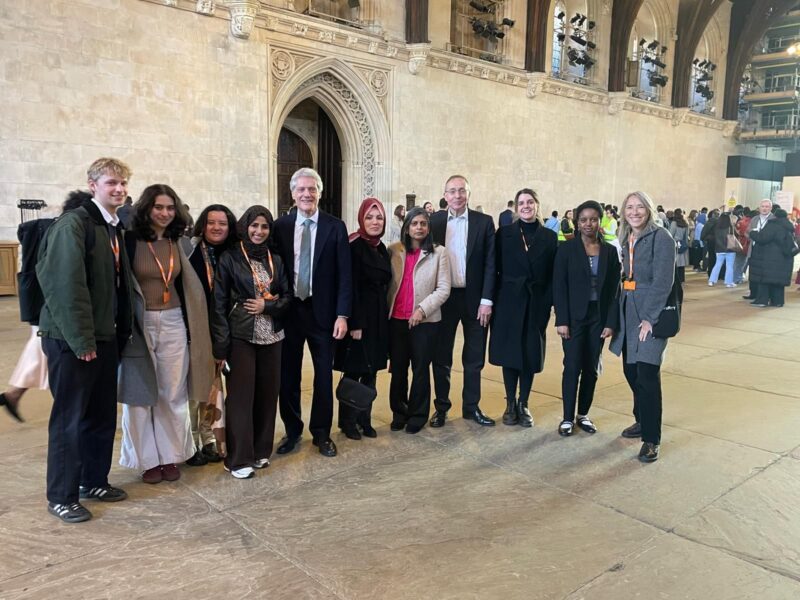
I also met, together with fellow west London MPs, a group of refugees supported by the local charity West London Welcome, who had come to Westminster to share their concerns about proposed changes to asylum policy currently under consultation by the Home Secretary. It was a valuable opportunity to hear directly about the potential impact of those proposals from those with first-hand experience of the system.
Leiths Education
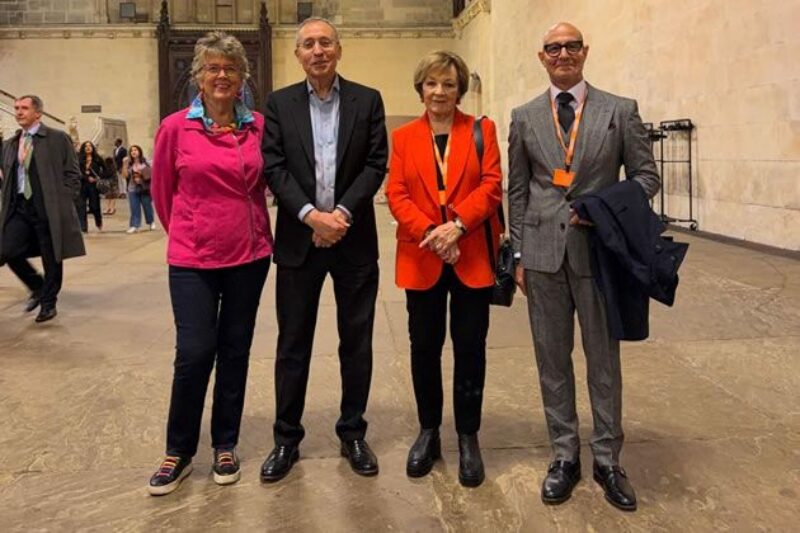
Prue Leith, who runs her long-standing and hugely successful cookery school in Shepherds Bush came to Parliament recently for the launch of her primary school cookery project, and I had the pleasure of giving her a tour of the Palace of Westminster. What I didn’t expect is that she would bring with her Delia Smith and Stanley Tucci. The project to teach all state primary school children the joys of cooking is a great venture and it was a very positive event. I hope our special guests found the catering in the House of Lords up to their standards.
Local education visits
Engaging with local school students is one of the best parts of being an MP. This week I welcomed Year 6 pupils from Belmont School in Chiswick to Parliament. After their tour of the Commons, we took advantage of the lovely spring weather to spend some time in Victoria Gardens, where I spoke with them and answered questions while they had their lunch in the sun.

I was delighted to join the Hammersmith Community Gardens Association, Cllr Rowan Ree, and pupils from Greenside Primary School, for the planting and opening of a newly redesigned space outside the school. The project, supported by investment from the council’s Green Investment Fund, has transformed an area that had been associated with anti-social behaviour into a safer and more welcoming environment, incorporating a sustainable urban drainage scheme. It was encouraging to see the involvement of both the school community and local residents in bringing the project to completion.
I recently visited the University of the Arts London’s School of Pre-Degree at Lime Grove in Shepherd’s Bush, where I was given a tour of its new campus and met with Dean, Amanda Jenkins. The school has now fully relocated to the site and brings together around 1,300 students studying pre-degree courses, providing a space for young people to develop creative and technical skills before progressing to higher education or apprenticeships. It was also an opportunity to discuss the potential impact of proposed Level 3 reforms on these courses. The campus is an impressive facility, with access to specialist equipment and teaching, and is a good example of the kind of creative education provision that has chosen to base itself in the borough.
Earlier this week I attended an event at The Rhythm Studio Foundation in Hammersmith to mark its 15th anniversary and to see more of its work supporting young people in music. The charity provides access to high-quality studio equipment, tuition and performance opportunities, particularly for those who might not otherwise have access through school or at home. The evening included a tour of the studios and performances from young artists supported through its scholarship scheme, and it was encouraging to see the role it plays in making music education more accessible across the borough.
I visited Bute House school to hear about their charitable work locally in Brook Green and also West London College for College’s Week, to hear about their plans for the future.
I also attended an event at Gunnersbury Park Sports Hub marking the 20th anniversary of the Premier League Kicks programme, which uses football to engage young people and support safer communities. It was an opportunity to hear directly from participants and coaches about the impact of the programme, which has supported over 600,000 young people through more than one million hours of free sessions, mentoring and education. The link between youth provision and reductions in anti-social behaviour came through clearly, as did the importance of sustained investment in this kind of work.

There are two excellent local concerts taking place on the same evening this weekend, so residents may have a difficult choice to make. The Fulham Symphony Orchestra will be performing its Spring concert on Saturday 21 March at 7.30pm at St Paul’s Church, Hammersmith, continuing its tradition of ambitious and well-received programmes.
At the same time, the Addison Singers will be holding their Spring classical concert at 7.30pm at St Peter’s Church, Southfield Road, W4 1BB. As one of west London’s leading amateur choirs, their performances are always of a high standard. It’s a good dilemma to have, and whichever you choose, you’ll be supporting live music in the borough.
Sadly I can’t attend either, as I’m already booked to watch Chiswick School’s performance of Carmina Burana, which is also on the same day, which should be a lively and ambitious production.
Eid Mubarak

As the holy month of Ramadan ends, Muslim constituents and many others will be celebrating Eid.
As always I’ve been delighted to attend Iftar meals (breaking of the fast) including joining more than 100 constituents at the White City Community Centre. The evening was organised by Mostafa Ragab of the Egyptian Association, with food prepared by a large team of volunteers.
Eid is a time for celebration and I will be visiting local mosques and celebrations over the next few days. It’s a huge pleasure to celebrate the success of the many cultures and religions represented across Hammersmith and Chiswick, and a reminder of the strength of living in a multicultural society.
I was pleased to see that Culture House in Hammersmith, which opened last May, has secured funding from the Loved and Wanted Community Fund. The centre plays an important role in sharing the stories and heritage of the British Somali community, while creating a space for wider cultural exchange and understanding. This support will help it continue to develop that work and strengthen its presence in the borough.